[text](url)
Best Safety Shoes in Singapore: Choosing the Right Certified Work Footwear
Choosing the best safety shoes in Singapore is not simply about finding the toughest-looking pair or the cheapest option available. The right footwear needs to match the hazards of the job, meet the relevant safety standard, fit properly, and remain practical for workers who may spend eight or more hours on their feet.
This matters across Singapore's construction sites, fabrication yards, warehouses, manufacturing facilities, marine environments, workshops and other industrial workplaces. A worker may be exposed to falling objects, sharp materials, slippery floors, heavy equipment, heat or other hazards during the same shift. The footwear needs to address the risks that actually exist rather than simply carrying a generic "safety shoe" label.
Singapore's workplace-safety framework places responsibility on employers to identify workplace hazards and implement effective risk controls. Personal protective equipment is part of that wider approach, rather than a substitute for proper workplace controls.
For businesses purchasing footwear for a workforce, this also means looking beyond the appearance of a shoe. Certification documents, sizing availability, durability, workplace requirements and compatibility with other PPE can all affect whether a product is suitable.
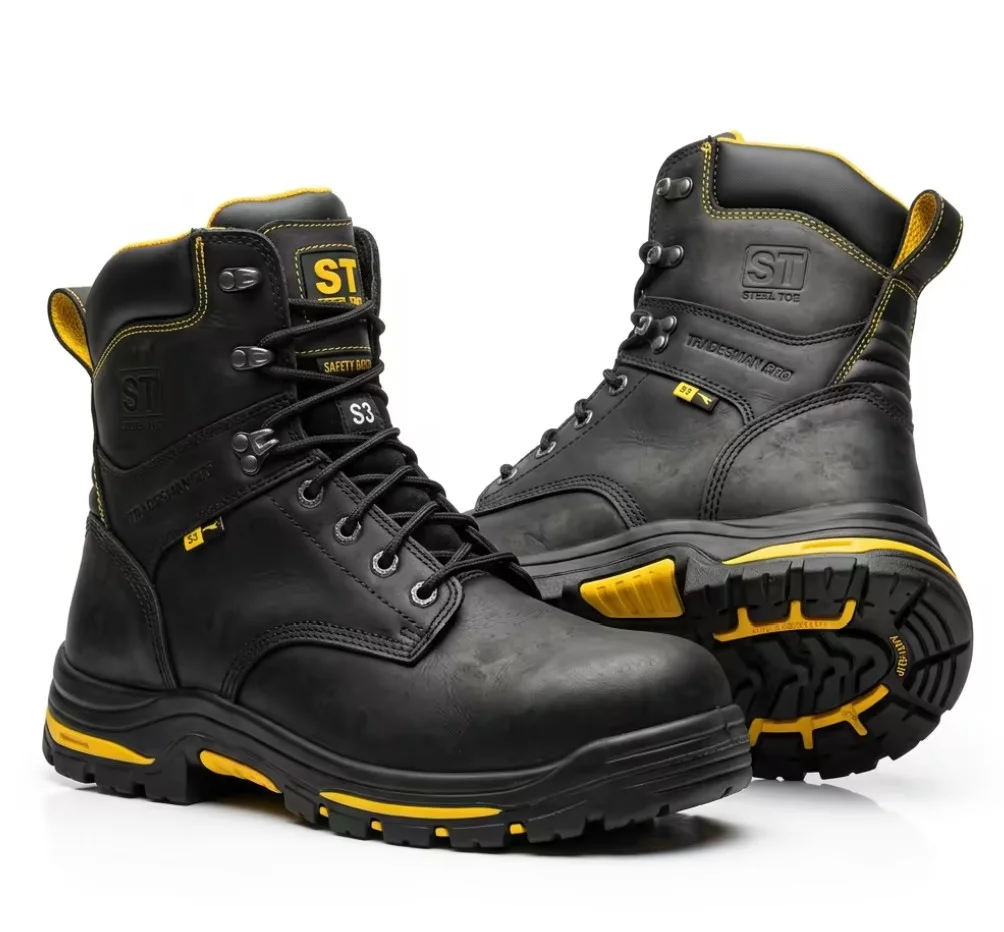
Kaye Kaye Safety Solution supplies industrial safety footwear as part of a broader range of head-to-toe PPE for construction, civil engineering, welding, marine, oil and gas, manufacturing and heavy-industry environments. Its current footwear range includes heavy-duty steel-toe and anti-slip options and references EN ISO 20345 S3 for its safety-footwear category.
What Makes Safety Shoes Suitable for Singapore Workplaces?
Suitable safety footwear should be selected according to the hazards identified in the workplace.
For example, a worker handling heavy materials may need reliable toe protection, while someone working on wet surfaces may place greater importance on slip resistance. A worker spending most of the day walking around a warehouse may have different comfort requirements from someone working on uneven outdoor construction surfaces.
The Ministry of Manpower requires employers to take reasonably practicable measures to protect workers and to conduct risk assessments to identify hazards and implement appropriate controls.
Footwear therefore needs to be considered as part of the overall risk-control process.
Singapore also has a specific approved code of practice for protective footwear. The Workplace Safety and Health Council's 2024 notification updated SS 513:2024, covering personal protective equipment for footwear and the associated test methods. The updated notification took effect from 1 January 2025.
What Should You Check Before Buying Safety Shoes?
The first thing to establish is the hazard.
If the job involves objects that could fall or roll onto the foot, appropriate toe protection is important. If workers regularly encounter wet or contaminated surfaces, slip resistance becomes a significant consideration. If the work involves electrical hazards, specialised footwear requirements may apply and should be assessed separately.
The second consideration is the applicable safety standard.
A product description that simply says "industrial safety shoe" does not provide enough information to establish whether the footwear is suitable. Procurement teams should request the manufacturer's technical documentation and verify the standard and performance classifications of the exact model being purchased.
The third consideration is fit.
Even certified footwear can become a poor choice if workers cannot comfortably wear it throughout a shift. A shoe that is too narrow can create pressure points, while one that is too loose may reduce stability. Workers should have enough room for natural toe movement without allowing the heel to move excessively.
Finally, consider the working environment. Singapore's heat and humidity make breathability, moisture management and overall comfort particularly relevant for workers who spend long hours outdoors or in warm industrial environments.
Safety Shoes vs Safety Boots: Which Is More Suitable?
The difference is mainly in the design and level of coverage rather than simply the word used to describe the product.
Safety shoes are generally lower-cut and can provide greater freedom of movement around the ankle. This can make them practical for indoor workplaces such as warehouses, workshops and manufacturing environments where workers spend much of the day walking on relatively level surfaces.
Safety boots extend higher around the ankle and may provide additional support and coverage for work environments involving uneven ground, outdoor construction activities or more demanding site conditions.
Neither design is automatically suitable for every worker.
A construction worker moving across uneven surfaces may have different footwear requirements from someone working inside a logistics warehouse. The correct choice should therefore follow the hazards identified in the specific job rather than assuming that a boot is always safer than a shoe.
Steel Toe or Composite Toe: Which Should You Choose?
Steel toe protection remains widely used for demanding industrial applications because steel provides strong mechanical protection while remaining a familiar and established solution.
However, weight can become a consideration when footwear is worn for a full working day. This is where non-metallic toe-cap designs can be useful.
Composite toe caps can use materials such as reinforced polymers, fibreglass or other engineered materials instead of steel. Depending on the product, they can reduce weight and may offer advantages in environments where non-metallic footwear is desirable.
The important point is that material alone does not determine whether a shoe is suitable.
A composite toe shoe should still be assessed according to the certification and performance documentation for that specific model. Similarly, a steel toe does not automatically mean a particular shoe is appropriate for every industrial hazard.
For procurement teams, the practical question is whether the toe protection meets the required standard and performance level for the workplace.
Why Does Slip Resistance Matter in Singapore?
Slip hazards are relevant in many Singapore workplaces, particularly where floors can become wet, oily or contaminated.
Construction sites, workshops, food-related work areas, warehouses and outdoor environments can all present different forms of slip risk.
MOM has previously highlighted non-slip footwear as one measure that can help prevent slips, trips and falls.
The outsole therefore deserves as much attention as the toe cap when selecting industrial footwear.
Buyers should consider the surface workers actually encounter rather than choosing a shoe simply because its product description contains the words "anti-slip." Where a workplace has particularly demanding conditions, the relevant performance information should be checked against the manufacturer's documentation.
What Safety Shoes Are Suitable for Long Shifts?
Comfort becomes increasingly important when footwear is worn throughout an entire shift.
A worker may spend several hours walking, standing, climbing stairs or moving between work areas. Heavy or poorly fitting footwear can contribute to discomfort long before the end of the working day.
Look at the overall construction of the shoe, including the insole, cushioning, heel support, upper material and ventilation. Breathable materials can also be useful in Singapore's warm climate, although breathability should never come at the expense of the protection required for the job.
Fit should also be tested with the type of socks workers normally wear. For company-wide procurement, providing several size options and allowing workers to confirm their fit before a large order can reduce sizing problems later.
The most protective shoe is not necessarily the most appropriate one if workers cannot wear it correctly or comfortably for the duration of their shift.
Safety Footwear for Construction and Civil Engineering
Construction and civil engineering environments can expose workers to several hazards at once.
Workers may encounter uneven surfaces, construction materials, tools, wet areas, heavy equipment and objects that could fall or roll. Outdoor exposure can also mean workers spend long periods in Singapore's heat and humidity.
For these environments, footwear selection should consider toe protection, outsole performance, durability, fit and the requirements of the specific site.
A company purchasing footwear for a construction workforce should also check whether individual projects have their own PPE specifications. A site may require a particular standard, colour, design or additional feature beyond the general requirements of the employer.
Kaye Kaye Safety Solution positions its industrial PPE range around construction and civil engineering applications and supplies safety footwear alongside other protective equipment such as helmets, gloves, workwear and fall-protection systems.
Safety Footwear for Marine, Oil and Gas Work
Marine and heavy industrial environments can present particularly demanding conditions for footwear.
Workers may encounter wet surfaces, metal structures, uneven walkways, heavy equipment and prolonged outdoor exposure. Oil and gas and petrochemical environments can introduce additional hazards that require more specific PPE selection.
In these settings, procurement teams should not select footwear solely based on whether it is described as "industrial." The actual site conditions, work processes and applicable PPE requirements should determine the specification.
Kaye Kaye Safety Solution identifies marine, oil and gas, petrochemical, construction, manufacturing and heavy-industry environments among the sectors it serves. Its Singapore operation also supports business customers with bulk quotations and site-safety assistance.
That broader approach can be useful for companies purchasing multiple categories of PPE at the same time, particularly when footwear needs to be considered alongside helmets, gloves, workwear and fall protection.
Safety Shoes for Warehouses and Manufacturing
Warehouse and manufacturing workers can spend much of their day standing and walking on hard floors.
In these environments, the ideal footwear often needs to balance protection with comfort and mobility. Workers may handle boxes, equipment, tools or manufactured components, while forklifts and other machinery may operate nearby.
Slip resistance can also become important where floors are exposed to water, oil or other substances.
For precision manufacturing or assembly environments, workers may additionally need footwear that does not unnecessarily restrict movement.
The exact requirements depend on the work performed. A worker moving heavy components has different needs from someone performing fine assembly or inspection work.
This is why companies should avoid issuing one generic shoe to every employee simply because it is easier to manage.
Does Singapore's Climate Affect Safety Shoe Selection?
Yes, the climate can affect comfort and durability, although the required protective performance should always come first.
Singapore's warm and humid conditions can make enclosed footwear uncomfortable during long shifts, particularly for workers spending substantial time outdoors.
Breathable uppers, moisture-management features and suitable internal cushioning can improve comfort. Materials should also be appropriate for the working environment, particularly where footwear is exposed repeatedly to water, dirt, oils or other contaminants.
Employers should also consider heat stress as part of the wider workplace-safety picture. PPE is only one part of keeping workers safe in Singapore's climate.
MOM's workplace-safety guidance places responsibility on employers to assess workplace risks and implement suitable controls.
How Should Companies Buy Safety Shoes in Bulk?
Bulk PPE purchasing requires more planning than simply multiplying the price of one pair by the number of workers.
Procurement teams should first identify the different worker groups and their respective hazards. From there, the company can establish which footwear specifications apply to each role.
The exact product documentation should then be checked, including the applicable safety standard and performance classification.
Sizing is another practical issue. A bulk order containing hundreds of pairs is not useful if a significant proportion of workers cannot find a suitable fit.
Companies should also consider replacement requirements. Safety footwear is a consumable part of a PPE programme and may need to be replaced when the outsole, upper, toe protection or other components become damaged or worn.
For larger projects, working with a PPE supplier that can discuss the workplace application before quoting can make the purchasing process more straightforward.
Kaye Kaye Safety Solution specifically provides B2B support for bulk quotations and site-safety inspections, alongside its wider head-to-toe PPE range.
Why Consider Kaye Kaye Safety Solution for Safety Footwear in Singapore?
Kaye Kaye Safety Solution supplies industrial safety footwear as part of a wider PPE system for Singapore and Southeast Asian workplaces.
Its current footwear category describes heavy-duty steel-toe and anti-slip footwear for high-risk fabrication and industrial environments and references EN ISO 20345 S3 for the safety-footwear category.
The company also supplies head protection, protective gloves, industrial coveralls and fall-protection equipment. This makes its offering relevant to businesses that need to equip an entire workforce rather than purchase footwear as a standalone product.
Its current B2B service also includes bulk quotation support, site safety inspections and job-specific safety recommendations.
For a company outfitting a construction crew, fabrication team, marine workforce or industrial operation, this allows the discussion to start with the work environment and required protection rather than simply choosing a shoe from a catalogue.
What Should You Ask a Safety Footwear Supplier?
A useful quotation request should include the work environment, the main hazards, the number of workers, required sizes and any site-specific PPE requirements.
If the company has already completed a risk assessment, providing that information can help the supplier understand what protection is actually needed.
It is also worth asking for the technical documentation of the exact footwear model rather than relying solely on a product photograph or general description.
For bulk orders, companies should clarify lead times, sizing availability, replacement arrangements and whether samples can be provided before the full order is placed.
This is particularly important when purchasing footwear for a large workforce because a product that works well for one worker may not be appropriate for every role on the same project.
Frequently Asked Questions
Are safety shoes mandatory for every worker in Singapore?
No. PPE requirements depend on the hazards present in the workplace and the employer's risk assessment. Singapore's Workplace Safety and Health framework requires employers to identify hazards and implement effective risk controls, including suitable PPE where required.
What safety standard should I look for when buying safety footwear in Singapore?
Singapore's approved code of practice includes SS 513, with the current 2024 revision covering personal protective equipment for footwear and its test methods. Other recognised international standards may also be relevant depending on the product and workplace requirements.
Are composite toe safety shoes as suitable as steel toe shoes?
Composite toe footwear can provide certified toe protection without using steel, but suitability depends on the specific product's tested performance and the workplace hazard. Buyers should verify the certification and performance of the exact model rather than choosing based on toe-cap material alone.
How often should safety shoes be replaced?
There is no universal replacement period that applies to every worker. Footwear should be inspected regularly and replaced when protection or structural integrity has been compromised. Signs can include a badly worn outsole, damaged upper, separated sole, damaged toe area or deterioration that affects the shoe's protective function.
Are safety shoes suitable for Singapore's hot and humid weather?
They can be, provided the footwear combines the protection required for the workplace with suitable comfort features. Breathable materials, appropriate cushioning and good fit can help during long shifts, but climate comfort should never override the safety specification required for the job.
Can a company purchase safety shoes together with other PPE?
Yes. For companies equipping an entire workforce, purchasing footwear alongside helmets, gloves, workwear and fall-protection equipment can simplify procurement. Kaye Kaye Safety Solution currently provides a broader head-to-toe PPE range and B2B support for bulk quotations and site-safety inspections.
Need On-Site Safety Assistance?
Speak directly to our safety specialists for transparent quotes and fast dispatch across Singapore.