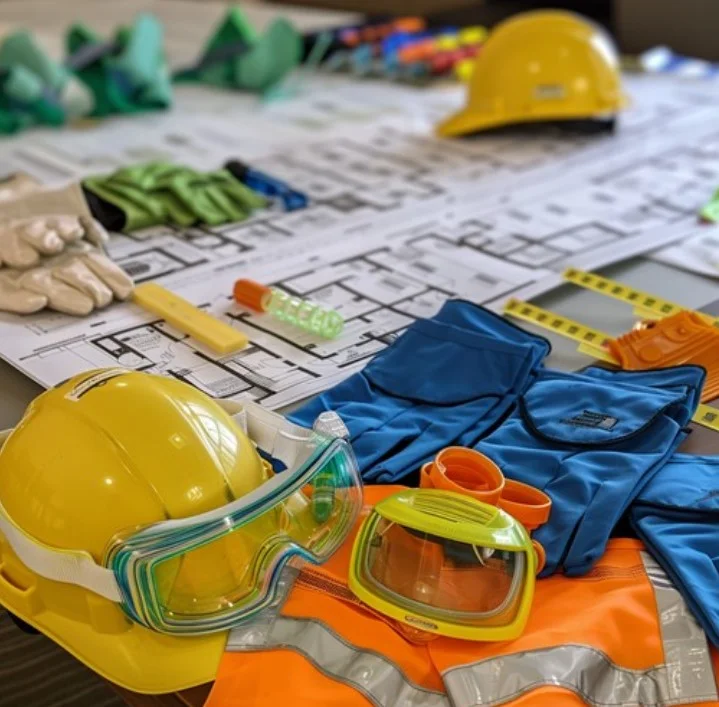
Construction safety gear in Singapore should be selected according to the hazards workers actually face on site rather than from one universal PPE checklist.
A worker performing welding can require different eye, face, hand and body protection from someone drilling concrete, handling materials at ground level or installing equipment at height. Even workers on the same project may therefore need different combinations of personal protective equipment.
Singapore's Workplace Safety and Health framework requires workplaces to assess risks and implement appropriate controls. The WSH Council's hierarchy of control places elimination, substitution and engineering measures ahead of administrative controls and PPE. Personal protective equipment should therefore be used after upstream measures have been considered and as protection against residual risks that remain.
For construction companies, this means issuing every worker a helmet, vest and pair of boots is not enough by itself. Each activity should first be assessed, the remaining hazards identified, and the required PPE selected according to those risks.
Kaye Kaye Safety Solution supplies specialised PPE for construction, civil engineering, scaffolding, welding, marine, oil and gas and other higher-risk environments in Singapore and Southeast Asia. Its current range includes safety helmets, protective gloves, steel-toe safety footwear, industrial coveralls and fall-protection systems, allowing companies to source several worker-protection categories through one supplier.
For contractors and procurement teams, the most practical sequence is therefore: understand the task, identify the remaining hazard, determine the required protective performance, verify the product standard, check compatibility and fit, and only then compare suppliers and prices.
Quick Answer: What PPE Does a Construction Worker Need in Singapore?
Common construction PPE in Singapore can include a safety helmet, safety footwear, protective gloves, eye or face protection, hearing protection, respiratory protection, protective workwear and fall-protection equipment. However, not every worker needs exactly the same equipment. The required combination depends on the task and risk assessment.
A worker drilling concrete may need eye, hearing and respiratory protection. A welder may require welding-specific face, hand and body protection. Someone exposed to a fall risk may need a properly designed fall-protection system in addition to baseline site PPE.
The correct PPE is therefore task-specific, hazard-specific and compatible with the other equipment being worn.
Why Does Construction Safety Gear Matter in Singapore?
Construction workers can encounter falling objects, sharp materials, moving machinery, dust, noise, hot work, slippery surfaces and falls from height during one project.
PPE reduces the consequences of those hazards when they cannot be fully removed through stronger controls. For example, securing materials and restricting access below overhead work should come before relying on a helmet. The WSH Council recommends preventing falling-object incidents through measures such as securing loose items, installing catch platforms or overhead protection and demarcating hazardous areas, while also using suitable PPE such as safety helmets and safety footwear.
Work at height follows the same principle.
Falls remain the top contributor to workplace deaths in Singapore, accounting for more than one-third of annual workplace fatalities. The WSH Council recommends safe access, guardrails, scaffolds, covered openings, travel-restraint systems and individual fall-arrest systems where appropriate.
PPE should therefore be viewed as one layer within the site's entire safety system, not as a substitute for proper planning, engineering controls, safe work procedures or supervision.
What Construction Safety Gear Is Commonly Needed?
Common PPE categories include head protection, eye and face protection, hearing protection, respiratory protective devices, protective gloves, safety footwear, workwear and fall-protection equipment.
The exact combination depends on the work activity.
A worker carrying materials at ground level may need a helmet, safety footwear and suitable gloves. A worker grinding steel can require those items together with suitable eye and face protection and hearing protection. A worker drilling concrete may additionally require respiratory protection.
A worker carrying out welding can require specialised welding PPE.
Someone exposed to work-at-height risks may require a complete fall-protection system where the hazard cannot first be eliminated or prevented.
The purpose of the risk assessment is to establish which of these protections actually applies.
What PPE Is Needed for Concrete Drilling and Cutting?
Concrete drilling, cutting and similar work can create flying particles, airborne dust and substantial noise. Eye protection may therefore be needed to prevent particles reaching the eyes. Face protection can be appropriate where a larger area of the face is exposed.
Respiratory protection may also be required depending on the dust and exposure level. The correct respirator should be selected according to the contaminant rather than simply using whichever disposable mask is available. Hearing protection can be required where noise exposure reaches harmful levels.
The first priority should still be controlling the hazard at its source through methods such as suitable extraction, dust suppression, quieter equipment or isolation where reasonably practicable. PPE then addresses the residual exposure.
What PPE Is Needed for Welding and Hot Work?
Welding introduces a different combination of hazards.
Workers may face intense optical radiation, sparks, hot particles, heat and sharp metal. Appropriate welding eye and face protection, thermal gloves, suitable protective workwear and safety footwear can therefore form part of the PPE system. The protection should be specific to the welding process rather than assuming ordinary safety glasses, general handling gloves or standard workwear are automatically sufficient.
Hot-work controls, ventilation, fire prevention, equipment condition and appropriate work procedures also remain necessary. A worker who welds only during one part of the shift may also require different gloves or eye protection when returning to general material handling.
What PPE Is Needed for Material Handling?
Material handling can expose workers to falling items, sharp edges, rough surfaces and foot injuries. Safety footwear and appropriate gloves are common considerations, while head protection may be required where overhead or falling-object hazards exist.
The glove should match what is actually being handled.
Sharp sheet metal can justify greater cut resistance than finished timber products, while wet or oily materials may create additional grip requirements.
Likewise, the safety footwear should correspond to impact, slip and underfoot hazards rather than being selected solely because it is described as an industrial boot.
What PPE Is Needed for Work at Height?
Work at height should first be designed to prevent a fall.
Guardrails, proper scaffolds, opening covers and travel-restraint systems can prevent workers from reaching a fall hazard. Individual fall-arrest equipment becomes relevant where residual fall exposure remains.
A worker at height may also need a helmet suited to the task, safety footwear and task-specific hand or eye protection. However, adding more PPE does not compensate for an unsafe work platform, inadequate anchorage or poor access. The complete fall-protection system and rescue arrangements are especially important and should be considered before work begins.
What PPE Is Needed for Grinding and Metal Fabrication?
Grinding and fabrication can expose workers to particles, sparks, sharp metal, noise and sometimes hot surfaces. Eye and face protection, suitable gloves, hearing protection, safety footwear and appropriate workwear may therefore be required depending on the activity.
Gloves should be selected carefully around machinery because glove use itself can create entanglement hazards around exposed rotating parts.
The risk assessment should therefore consider not only what PPE protects against, but whether wearing it introduces another hazard during the specific operation.
Which Singapore Standards Apply to Construction PPE?
Singapore has different standards for different PPE categories. There is no single standard covering an entire construction-worker PPE kit.
Understanding these standards helps contractors verify whether products are being assessed against requirements relevant to the hazard.
What Standard Applies to Safety Helmets?
SS 98:2013, Specification for Industrial Safety Helmets, remains a current Singapore Standard. It covers physical and performance requirements, testing, marking, care and maintenance for industrial safety helmets.
Kaye Kaye's current helmet category references SS 98 and ANSI Z89.1 and includes high-impact ABS helmets, ventilated hard hats, full-brim designs and climbing-style helmets with adjustable chin straps.
Buyers should still verify the exact certification of the particular model being selected.
What Standards Apply to Eye Protection?
Singapore's current eye-protection standards include SS 473-1:2011, covering general requirements for personal eye protectors, and SS 473-2:2011, covering selection, use and maintenance.
SS 473-2 addresses hazards including mechanical and chemical exposure as well as non-ionising optical radiation. Both remain listed as current Singapore Standards.
The specific eye protector should therefore be chosen according to whether the worker faces impact, dust, splash, radiation or another hazard.
SS 548:2022 is Singapore's current Code of Practice for the selection, use and maintenance of respiratory protective devices.
It addresses respirator selection, use, maintenance and the establishment of a respiratory-protection programme for workplace contaminants and oxygen-deficient atmospheres.
This means respiratory protection should not be treated simply as purchasing masks. The employer needs to consider the contaminant, required protection, fitting, maintenance and programme management.
What Standard Applies to Hearing Protection?
SS 549:2009 remains the current Singapore Code of Practice for the selection, use, care and maintenance of hearing protectors. It includes guidance on selecting hearing protection and accounting for differences between laboratory attenuation values and real-world protection.
This supports a key practical point: the hearing protector with the greatest possible attenuation is not automatically the best choice if it interferes with communication or warning signals. Selection should follow the actual noise exposure.
What Standard Applies to Safety Footwear?
SS 513-1:2024 is Singapore's current specification for safety footwear.
It covers basic and additional requirements including mechanical risks, slip resistance, thermal risks and ergonomic behaviour. Specialised hazards such as electrical insulation, chemicals and molten-metal exposure are addressed separately. Kaye Kaye's current footwear category references EN ISO 20345 S3 and describes heavy-duty steel-toe and anti-slip footwear for higher-risk industrial environments.
Employers should still confirm the precise marking of the model being purchased.
What Standards Apply to Personal Fall-Arrest Equipment?
Singapore's WSH work-at-height resources reference the SS 528 Parts 1 to 6 series for personal fall-arrest systems. The series covers components including full-body harnesses, lanyards and energy absorbers, self-retracting lifelines, vertical lifelines, connectors and complete-system performance.
This is important because fall protection is a system, not merely a harness. Kaye Kaye's current fall-protection category references SS 528 and EN 361 and includes full-body harnesses, work-positioning belts and shock-absorbing lanyards.
What Head Protection Should Construction Workers Wear?
Safety helmets protect against hazards such as falling tools and building materials and accidental contact with fixed structures.
The correct helmet should reflect the work environment.
A general construction worker can have different requirements from someone climbing, working at height or operating in an environment where retaining the helmet securely on the head is particularly important. Kaye Kaye's current range includes high-impact ABS construction helmets, ventilated designs, full-brim options and climbing-style helmets with four-point adjustable chin straps.
Ventilation can improve comfort in Singapore's hot conditions, but protection and suitability for the task should remain the first considerations.
Helmets should also be inspected and maintained according to manufacturer instructions. A helmet involved in a significant impact should not automatically remain in use simply because there is no obvious external crack.
When Is Eye and Face Protection Required?
Eye and face protection becomes important where work can generate flying particles, dust, sparks, chemical splashes or harmful optical radiation.
Grinding, cutting, drilling and demolition can propel debris toward the worker. Safety spectacles can be suitable for particular impact hazards, while goggles may provide additional enclosure where dust or splash exposure is present.
Face shields provide broader facial coverage but should not automatically be treated as a replacement for primary eye protection where the hazard requires both.
Welding presents a specialised situation because the worker also requires protection from optical radiation and hot particles.
The equipment must therefore be appropriate for the welding process. Compatibility matters as well. Eye protection should continue to fit properly when combined with helmets, hearing protection or respiratory equipment.
When Do Construction Workers Need Hearing Protection?
Construction activities such as concrete breaking, drilling, cutting and piling can expose workers to high noise levels. The first consideration should be whether noise can be reduced through quieter equipment, isolation, barriers, maintenance or changes to the work process.
Where harmful exposure remains, hearing protection becomes relevant.
Earplugs and earmuffs offer different practical advantages, and the right choice depends on the noise exposure, working conditions and need to hear instructions or warning signals.
SS 549:2009 provides Singapore guidance on selecting, using, caring for and maintaining hearing protectors. The goal is therefore sufficient protection rather than maximum possible attenuation in every situation.
What Respiratory Protection Is Needed on Construction Sites?
Construction activities can generate dust, fumes, vapours and other airborne contaminants.
Concrete cutting and drilling can create particulate exposure, while painting, spraying, welding or chemical applications can introduce different respiratory hazards.
A disposable particulate respirator and a reusable respirator fitted with specialised filters or cartridges do not perform the same function.
The employer should identify the airborne hazard first and then choose a respirator appropriate to that contaminant and exposure.
SS 548:2022 provides Singapore guidance on respirator selection, use and maintenance and establishing a respiratory-protection programme.
Respirators should also be used alongside upstream controls such as ventilation, extraction and process modification rather than as a substitute for those measures.
Do Construction Respirators Need Fit Testing?
For tight-fitting respiratory protection, achieving an effective facial seal is critical.
Singapore WSH guidance states that fit testing should be conducted to ensure respiratory protective devices fit the wearer adequately. More recent WSH occupational-health guidance also states that fit testing must be carried out to ensure adequate respirator protection.
A tight-fitting respirator should therefore not be assumed to suit every worker simply because it is available in one common size.
Facial shape, sizing, facial hair and the exact respirator model can all affect the seal. Workers should also understand that a fit test and the user seal check performed when the respirator is worn are not the same thing.
Respirator selection should be managed as part of a programme rather than as a one-time equipment purchase.
How Should Construction Gloves Be Selected?
Construction gloves should be matched to what the worker handles.
Sharp steel or rough materials can require cut and abrasion protection.
Chemical handling may require gloves tested against the specific substance.
Hot work can require thermal protection, while electrical tasks may require specialised insulating gloves. Kaye Kaye's current hand-protection category describes gloves for cut, chemical and thermal hazards with rubberised palm grip and references EN 388 and EN 374.
Grip can be especially important on construction sites affected by rain, humidity, oil or other contaminants. However, a glove that grips well is not automatically suitable for every hazard.
Employers should also remember that gloves can create entanglement risks around some rotating machinery, so glove use itself must form part of the task-specific risk assessment.
Fit and dexterity matter as well. If a glove is so bulky that the worker continually removes it to complete the task, a different compliant model may provide a better practical solution.
What Safety Footwear Is Suitable for Construction Work?
Construction footwear should address the specific foot hazards identified at the site.
These can include falling materials, sharp debris, slippery surfaces, wet conditions and uneven ground. The WSH Council recommends suitable safety footwear as part of protection against falling objects, alongside upstream measures that prevent materials from falling in the first place.
SS 513-1:2024 provides Singapore's current general safety-footwear specification, covering areas such as mechanical hazards and slip resistance.
Kaye Kaye's current footwear range describes heavy-duty steel-toe and anti-slip products and references EN ISO 20345 S3. The correct footwear still depends on the job.
A worker operating indoors on a relatively controlled surface can have different needs from someone moving across wet outdoor construction ground.
Comfort, fit and total footwear weight also matter because construction employees can spend many hours walking, standing and climbing.
What Workwear Should Construction Workers Use?
Construction workwear provides coverage and can contribute to visibility and protection from the working environment. General workwear may prioritise durability and visibility.
Welding, hot work, chemical exposure or specialised thermal hazards can require garments tested for those particular risks. Kaye Kaye's current industrial-coverall category describes heavy-duty garments with retro-reflective elements and flame-retardant and chemical-protection features.
Buyers should verify the exact certification of the garment chosen for specialised protection rather than relying on a category description alone.
Singapore's climate should also be considered.
Protective clothing can contribute to heat burden, so employers need to find a compliant garment that workers can wear properly while continuing to manage heat exposure through appropriate site controls.
What Fall Protection Is Needed for Work at Height?
Work at height should begin with fall prevention rather than with a harness.
The WSH Council recommends proper access, guardrails, scaffolds, covers for openings and travel-restraint systems where appropriate. Individual fall-arrest systems are used where workers remain exposed to a residual fall risk. This distinction matters because a harness does not prevent a fall from happening.
A personal fall-arrest system is designed to stop the fall after it begins and limit the consequences. That makes system design, anchorage and available clearance critical.
What Makes a Complete Fall-Arrest System?
A complete personal fall-arrest system involves more than a full-body harness. The system can include the full-body harness, suitable connectors, an energy-absorbing lanyard or self-retracting lifeline, and a secure anchorage or lifeline system.
The SS 528 series reflects this system approach by addressing individual components and complete-system performance separately.
Available fall-clearance distance also matters.
WSH guidance notes that a shock-absorbing lanyard should only be used where there is sufficient fall-clearance distance and identifies self-retracting lifelines as an option where immediate arrest is required.
Workers must also remain connected to appropriate anchor points as required by the work-at-height system. A high-quality harness connected incorrectly or to an unsuitable anchor is not a safe fall-arrest solution.
Is a Rescue Plan Needed After a Fall Arrest?
Yes. Fall protection planning needs to consider what happens after the equipment successfully arrests a fall.
Singapore's WSH Council states that a site-specific Fall Prevention Plan should address emergency response as part of work-at-height management.
A worker who has fallen and remains suspended cannot simply be left hanging while the site decides what to do. Emergency procedures, communication and appropriate rescue capability should therefore be established before hazardous work at height begins.
This is one reason fall protection should never be treated purely as a procurement decision involving harnesses and lanyards.
The equipment, work method, anchor system, training and emergency response all need to function together.
Can Different PPE Items Interfere With Each Other?
Yes.
PPE products can be individually suitable but perform poorly when worn together.
For example, helmet-mounted earmuffs need to fit the helmet correctly.
Goggle or spectacle arms can interfere with the seal of some respiratory protection. A respirator can affect the fit of a face shield.
A bulky glove can interfere with connectors or controls.
Protective workwear can affect the fit and positioning of a harness.
This means compatibility should be assessed before a complete PPE kit is standardised across the workforce.
The WSH Council notes that PPE effectiveness depends on correct selection, fitting, consistent use and maintenance.
For contractors buying several categories of equipment, checking the complete combination before a large order can prevent situations where individually compliant products do not function well together.
Why Does Fit and Comfort Matter in Singapore's Climate?
Workers are more likely to use PPE correctly when it fits properly and does not introduce unnecessary discomfort.
Singapore's construction environment can be hot and humid, particularly for workers exposed outdoors.
Poorly fitted PPE can add heat burden, create pressure points, reduce visibility, restrict movement or interfere with the task.
Comfort should never justify removing protection that the risk assessment requires.
Instead, comfort should help employers choose between compliant alternatives.
For example, a ventilated helmet may be more wearable where the required protection allows it. A correctly sized glove can offer better dexterity. Properly fitted footwear can reduce unnecessary discomfort during long shifts.
Worker fitting before large-scale procurement can therefore improve both acceptance and correct PPE use.
How Should Construction PPE Be Inspected and Replaced?
Construction PPE should be inspected according to the equipment type, manufacturer instructions and site procedures. Workers should check equipment before use where required.
Helmets that have sustained significant impact, worn footwear, damaged gloves, defective respirators and compromised fall-protection equipment should not remain in service simply because replacement is inconvenient.
There is no one universal replacement interval that applies to every helmet, glove, harness or pair of footwear. Service life can depend on usage frequency, environmental exposure, contamination, storage, manufacturer requirements and incident history.
Fall-protection equipment deserves particular attention because defects in harnesses, connectors or lanyards can have severe consequences.
The safest approach is to establish inspection and retirement rules for each PPE category rather than using one generic replacement calendar.
How Can Contractors Manage Construction PPE Costs Without Sacrificing Safety?
Cost control should begin with accurate specification rather than simply buying the lowest-priced equipment. Over-specifying every item can increase cost unnecessarily.
Under-specifying can leave workers exposed and create greater operational and safety risk.
The objective is to purchase the protection required by the risk assessment.
Standardising suitable equipment across employees performing the same task can also improve procurement efficiency. If the same approved helmet, glove, footwear or fall-protection specification is used consistently for a particular worker group, replacement ordering and site supervision can become simpler.
Durability should be considered alongside purchase price.
A low-priced item that deteriorates rapidly may cost more over the life of the project than a more durable alternative.
Companies should also budget for inspection, replacement stock, storage and worker training because PPE provides value only while it remains usable and is worn correctly.
What Information Should Contractors Give a PPE Supplier Before Requesting a Quote?
A useful PPE quotation request should explain the project and work activities, not simply ask for the cheapest construction safety gear.
The supplier should understand what workers are doing, what hazards remain after other controls are applied and which standards or site specifications are required.
For helmet and footwear orders, workforce sizing and model requirements are important.
For gloves, describe the materials, chemicals, heat or sharp edges involved.
For respiratory equipment, identify the airborne contaminant and working environment.
For work at height, explain whether the requirement involves restraint, fall arrest, lifelines or other height-safety equipment.
If workers need to wear several PPE items simultaneously, that should also be discussed so compatibility can be considered. The contractor should then provide workforce quantity, sizes, expected replacement needs and project delivery requirements.
This creates a far more accurate quotation than requesting “50 sets of construction PPE” without explaining what those workers actually do.
What Does Kaye Kaye Check Before Recommending Construction PPE?
Based on Kaye Kaye's current B2B positioning, the discussion can begin with the work environment and required protection rather than a generic equipment package.
The company states that it supports scaffolding, construction, welding and marine oil-and-gas environments and positions its catalogue around head-to-toe workforce protection. Its current offerings include safety footwear, safety helmets, protective gloves, industrial coveralls and fall-protection harnesses.
For a construction PPE enquiry, useful information therefore includes the worker's task, site hazards, required standards, workforce quantity, sizing requirements and whether multiple PPE categories need to function together.
For workers at height, the discussion needs to go beyond harness size and consider the intended fall-protection arrangement.
For workers using respirators, the contaminant and fitting requirements matter.
For footwear and gloves, surface conditions, handling hazards and fit can influence the choice. This creates a more useful procurement conversation than simply ordering one identical “construction PPE set” for every employee.
Why Source Construction PPE From a Specialised Singapore Supplier?
A specialised PPE supplier can help contractors source equipment according to industrial applications rather than treating safety equipment like general hardware.
Kaye Kaye Safety Solution currently describes itself as supplying specialised PPE for scaffolding, construction, welding and marine oil-and-gas environments in Southeast Asia.
Its head-to-toe range includes footwear, helmets, gloves, industrial coveralls and fall-protection systems. The footwear category references EN ISO 20345 S3, its helmets reference SS 98 and ANSI Z89.1, its glove category references EN 388 and EN 374, and its fall-protection range references SS 528 and EN 361.
For contractors managing larger crews, sourcing several categories through one specialist supplier can simplify specification discussions, sizing, bulk ordering and compatibility review.
The practical benefit is not merely convenience.
It is the ability to approach PPE as a coordinated worker-protection system rather than purchasing each item independently.
Final Thoughts: What Construction PPE Does Your Job Site Actually Need?
Construction safety gear in Singapore should be built around the work activity and risk assessment, not around a standard shopping list.
Common PPE can include helmets, eye and face protection, hearing protection, respiratory devices, gloves, safety footwear, protective workwear and fall-protection equipment.
But the exact combination changes according to the task.
Workers drilling concrete can require eye, respiratory and hearing protection.
Welders can need specialised eye, face, hand and body protection.
Workers exposed to falling objects can require suitable head and foot protection alongside controls that stop objects falling in the first place.
Workers at height require fall-prevention planning before personal fall-arrest equipment is considered.
Singapore's current PPE standards reinforce the same principle. SS 98 applies to industrial safety helmets, SS 473 addresses eye protection, SS 548 covers respiratory protective devices, SS 549 covers hearing protectors, SS 513-1 covers safety footwear and the SS 528 series addresses personal fall-arrest systems.
Kaye Kaye Safety Solution supports this type of head-to-toe procurement through safety helmets, gloves, footwear, workwear and fall-protection systems for construction and other higher-risk industries.
For contractors and procurement teams, the most useful buying question is therefore not:
“What PPE set should we give every worker?”
It is:
“What hazard remains during this worker's actual task, which standard addresses that hazard, and which combination of compatible PPE provides the required protection without interfering with the work?”
Frequently Asked Questions About Construction Safety Gear in Singapore
Read More
Frequently Asked Questions
Need On-Site Safety Assistance?
Speak directly to our safety specialists for transparent quotes and fast dispatch across Singapore.