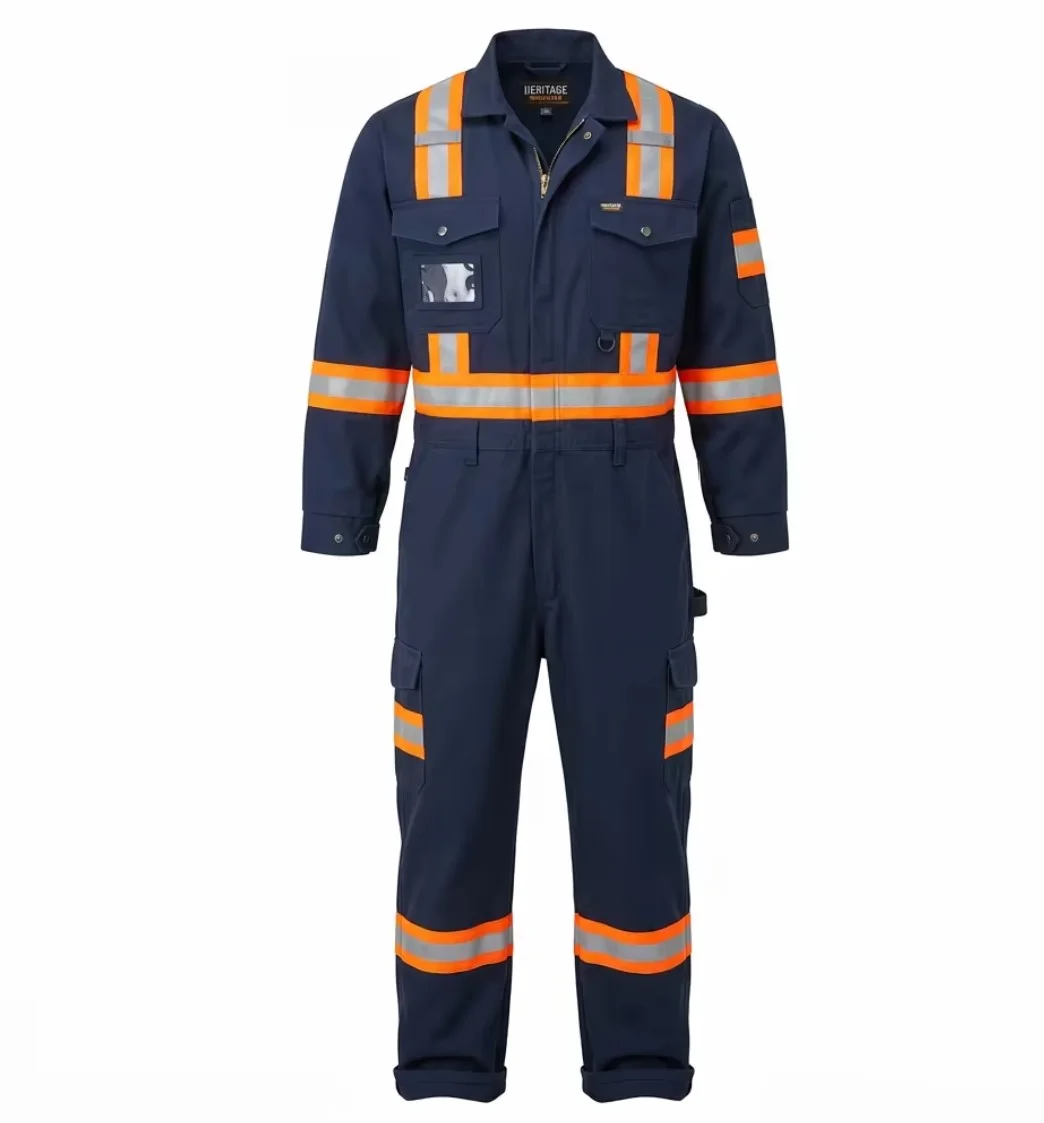
Choosing a work uniform supplier in Singapore is not simply about finding shirts, trousers or coveralls in the right colour. For construction crews, marine workers, welders, fabrication teams and employees in oil, gas or heavy industry, workwear also needs to cope with demanding physical conditions, Singapore's heat and humidity, and any protective requirements identified by the workplace risk assessment.
That makes industrial workwear different from ordinary corporate apparel.
Some uniforms mainly provide employee identification, consistency and basic coverage. Others are protective garments that may need tested performance against hazards such as flame, heat or reduced visibility. The distinction matters because a garment should never be treated as protective PPE simply because it looks heavy-duty or contains reflective material.
Kaye Kaye Safety Solution supplies industrial overalls and coveralls alongside safety footwear, protective gloves, helmets and fall-protection systems for higher-risk sectors in Singapore and Southeast Asia. Its current workwear catalogue describes heavy-duty industrial coveralls with retro-reflective accents, flame-retardant properties and chemical-protection features. The company also positions itself around B2B bulk sourcing, workforce protective deployment, job audits and specific safety recommendations.
Kaye Kaye also traces its workwear heritage to around 1981, when founder Mr. Ng Chee Chow began producing uniforms in Singapore. Its current industrial-safety business combines that garment-making background with specialised PPE sourcing.
For companies purchasing workwear for an entire workforce, the practical objective is therefore to select clothing that suits the job, fits employees properly, works with the rest of their PPE and can be sourced consistently when existing garments wear out or new employees join.
Quick Answer: How Do You Choose a Work Uniform Supplier in Singapore?
Choose a work uniform supplier by first deciding whether employees need an ordinary uniform or protective workwear. Then consider the work environment, applicable safety standards, Singapore's climate, garment durability, fit, compatibility with other PPE, workforce quantity and any branding requirements.
For bulk orders, also confirm the size range, replacement process and whether the same garment specification can be supplied for future employees. If the uniform performs a protective function, verify the exact certification of the individual garment rather than relying only on terms such as “FR,” “chemical protection” or “high visibility.”
What Does an Industrial Work Uniform Supplier Provide?
An industrial work uniform supplier provides clothing intended for actual working environments rather than focusing only on appearance.
The garment may need to withstand frequent bending, climbing, abrasion, outdoor exposure, repeated laundering and interaction with safety equipment.
A construction worker's trousers need to work properly with safety footwear. Coverall cuffs need to interact correctly with protective gloves. Workwear worn beneath a full-body harness should allow that harness to fit as intended.
This makes industrial uniform procurement partly an equipment decision.
Kaye Kaye's current workwear range focuses on industrial overalls and coveralls, while its broader catalogue also includes safety footwear, helmets, gloves and fall-protection equipment.
For employers requiring several PPE categories, considering these items together can make it easier to identify compatibility issues before equipment is issued to a larger workforce.
Are Work Uniforms and Protective Workwear the Same?
No.
An ordinary work uniform can provide identification, consistency, modesty and practical coverage without being certified as personal protective equipment.
Protective workwear is different because the clothing is intended to reduce exposure to a defined workplace hazard and should be tested or assessed according to the relevant protective standard.
For example, a durable cotton coverall can be entirely suitable as general industrial workwear without providing certified protection against flame.
Likewise, adding reflective strips to a uniform does not automatically make it certified high-visibility protective clothing.
A garment described as flame retardant should also not automatically be assumed suitable for welding, electrical arc exposure or every other thermal hazard.
This distinction should be established before ordering.
If the uniform is intended only for identification and general work coverage, comfort, durability and branding may be the main priorities.
If it is intended to protect the worker from a specific hazard, certification and performance become part of the procurement specification.
Which Standards Should You Check for Industrial Workwear?
The relevant standard depends on what the garment is intended to do.
There is no single certification that converts ordinary industrial clothing into universal protective workwear.
ISO 13688 provides general requirements covering areas such as ergonomics, size designation, ageing, compatibility and marking for protective clothing. Importantly, ISO states that it is intended to be used together with standards that define protection against particular hazards rather than as a standalone protective-performance standard. The current ISO 13688:2013 edition was reviewed and confirmed in 2024 and remains current.
For heat-and-flame hazards, ISO 11612:2015 remains the currently published standard. It covers protective clothing where limited flame spread and protection against defined forms of radiant, convective or contact heat or molten-metal splash may be required. A replacement edition is under development, but ISO 11612:2015 remains the published standard at present.
For certified high-visibility clothing used to make workers conspicuous around vehicles or mechanised equipment, ISO 20471:2013 remains the currently published international standard. It establishes requirements involving colour, retroreflection, minimum material areas and material placement. ISO is developing its replacement, but the 2013 edition remains published.
Other specialised hazards may require different clothing standards.
For procurement teams, this means the question should not simply be, “Does this garment have a standard?”
The better question is, “Is this the correct standard for the hazard this worker actually faces?”
What Is the Difference Between Reflective Workwear and Certified High-Visibility Clothing? Reflective material can make a garment easier to notice, but reflective strips alone do not necessarily establish that the entire garment meets a recognised high-visibility standard.
ISO 20471:2013 covers high-visibility clothing intended to visually signal the wearer's presence to vehicle and machinery operators under daylight conditions and under headlights in darkness. It specifies performance requirements not only for retroreflection but also for background colour, minimum material areas and placement.
This is an important distinction for construction, logistics, marine and industrial workplaces.
A coverall containing retro-reflective accents may provide useful added visibility while still not being the same as a garment specifically certified to ISO 20471.
Kaye Kaye describes its industrial overalls as incorporating high-visibility retro-reflective accents.
Where a project requires formally certified high-visibility protective clothing, buyers should therefore confirm the exact standard and classification of the garment being quoted rather than inferring certification from the presence of reflective strips.
What About Flame-Retardant Workwear?
Flame-retardant or flame-resistant workwear should be selected according to the actual thermal hazard.
ISO 11612:2015 is relevant where workers require clothing with limited flame spread and protection against specified heat exposures.
However, general heat-and-flame protection should not automatically be treated as protection for every type of hot work.
Welding, electric arc exposure and other specialised hazards can have their own requirements.
The garment's complete certification and performance marking therefore matter more than a general “FR” label.
Kaye Kaye's current workwear category describes its coveralls as having flame-retardant properties and displays ISO 11612 within the category.
Businesses should still confirm the exact certification of the individual coverall under consideration before issuing it for a specific hazardous task.
Does “Chemical Protection” Mean a Coverall Protects Against Every Chemical?
No.
Chemical protective performance cannot be assumed from a general product description.
Kaye Kaye's current site describes chemical protection as one of the features of its industrial overalls and coveralls.
However, ISO 11612 itself is a heat-and-flame standard, not a general chemical-protective clothing standard.
If the workplace risk assessment requires protection against chemical splash, liquid chemicals, particulates or another specific chemical exposure, procurement teams should request the relevant documentation for the individual garment and confirm what substances and exposure conditions it is designed for.
This prevents a buyer from assuming that one broad “chemical protection” statement covers every acid, solvent, oil or industrial chemical used at the facility.
Which Industries Need Specialised Work Uniforms in Singapore? Industrial workwear becomes particularly important where employees work around machinery, outdoor weather, abrasive environments, visibility risks or specialised thermal and chemical hazards.
The exact garment should follow the worker's activity rather than the industry name alone.
What Work Uniforms Are Suitable for Construction and Civil Engineering?
Construction workwear needs to tolerate movement, abrasion, dust, weather and regular contact with equipment.
Workers may spend substantial portions of their shifts bending, climbing, kneeling and carrying materials, so garment mobility is important.
Visibility can also matter around cranes, trucks, lifting operations and moving machinery.
Where a construction worker performs welding or another specialised task, the workwear requirement can change again.
Kaye Kaye specifically serves construction and civil-engineering environments and offers industrial workwear alongside helmets, gloves, safety footwear and fall-protection equipment.
For a contractor, it is therefore more useful to specify clothing by job role than simply ordering one construction uniform for every employee.
What Workwear Is Suitable for Marine, Offshore and Shipyard Workers?
Marine and shipyard workers can face heat, outdoor exposure, moisture, machinery and demanding physical movement.
Some roles may also involve welding, cutting or other hot work.
Workwear therefore needs to remain practical when combined with safety footwear, gloves, helmets and other equipment.
Heat stress deserves particular attention.
MOM currently requires hourly WBGT monitoring during outdoor work, and on-site WBGT meters are required for shipyards, process-industry workplaces and construction sites with contract sums of S$5 million or more.
Employers should therefore consider garment comfort as part of a wider heat-management system rather than expecting clothing alone to solve heat stress.
What Workwear Is Suitable for Oil, Gas and Petrochemical Operations?
Oil, gas and petrochemical workers can face very different hazards depending on their role.
Some may require general industrial clothing, while others can require garments intended for flame, heat, chemical or other specialised exposures.
The facility's risk assessment and site PPE requirements should determine the specification.
Kaye Kaye identifies oil, gas and petrochemical refineries among the sectors it serves and includes industrial coveralls within its head-to-toe safety range.
Where protective performance is required, buyers should verify each relevant standard rather than assuming a single industrial coverall provides universal refinery protection.
What Work Uniforms Are Suitable for Manufacturing and Heavy Industry?
Manufacturing workers may spend much of their shift standing, bending, assembling products, operating equipment and handling materials.
Durability and unrestricted movement are therefore important.
Workwear should not introduce loose material around machinery, nor should it be so restrictive that workers alter the garment or wear it incorrectly.
Depending on the process, additional PPE can include protective gloves, safety footwear, eye protection or respiratory equipment.
The uniform should therefore be considered together with these items rather than independently.
Kaye Kaye lists manufacturing, assembly and heavy industry among its main sectors.
What Workwear Is Suitable for Welding and Fabrication?
Welding and fabrication require more careful garment selection because workers may encounter sparks, hot materials and thermal exposure.
A garment should not automatically be treated as welding protective clothing because it is thick, long-sleeved or described as flame retardant.
The exact welding process and risk level should determine the required protective specification.
Kaye Kaye includes welding among the specialised environments it supplies and offers workwear alongside thermal gloves, safety footwear and other PPE.
For companies equipping welders, the discussion should therefore begin with the process and required protection rather than colour, branding or garment style.
What Fabric Is Best for Work Uniforms in Singapore?
There is no single best fabric for every work uniform.
For general industrial clothing, durability, comfort, movement and laundering requirements may be the main considerations.
Where the garment has a protective purpose, the performance of the finished clothing becomes more important than the fabric description alone.
A thick garment is not automatically more protective.
Likewise, a lighter garment should not automatically be considered safer for Singapore simply because it feels cooler.
The workplace needs enough protection for the identified hazard while avoiding unnecessary clothing burden.
MOM's current heat-stress requirements focus on a wider programme involving acclimatisation, hydration, rest, shade, hourly WBGT monitoring and other controls. At higher WBGT levels, MOM also requires or recommends additional measures such as work rescheduling, ventilation and suitable loose-fitting, light-coloured clothing where applicable.
Protective requirements should therefore not be reduced solely to make a uniform cooler.
How Should Companies Choose Workwear for Singapore's Heat and Humidity?
Workwear should provide the required coverage while allowing workers to move and work without unnecessary heat burden.
This is particularly relevant for outdoor construction, shipyard and process workers.
MOM requires workplaces to assess heat-stress risks and implement controls according to WBGT conditions. Outdoor WBGT should be monitored hourly, with additional rest requirements and other measures applying as heat levels increase.
Uniform design can support this programme through appropriate fit, fabric weight and ventilation where the protective requirement allows it.
However, no work uniform substitutes for shade, drinking water, rest, acclimatisation and appropriate work scheduling.
For specialised FR or other protective clothing, employers should select the most wearable compliant option rather than lowering the required protective performance.
Why Does Uniform Fit Matter for Industrial Workers?
Fit affects worker comfort, mobility, PPE compatibility and practical safety.
A garment that is excessively loose can snag on surrounding equipment.
A uniform that is too tight can restrict reaching, climbing, kneeling or bending.
Sleeves and trouser legs should remain appropriately positioned during movement rather than being assessed only while the employee is standing still.
Fit also affects other PPE.
Coverall cuffs need to interact properly with gloves.
Trouser legs should work with safety footwear.
A harness needs to sit correctly over the clothing.
For larger workforces, this is why bulk uniform orders should not be based solely on assumptions about employees' ordinary shirt or trouser sizes.
How Should Companies Size Work Uniforms for a Large Crew?
Start by selecting the intended garment model before finalising quantities.
Different industrial garments can fit differently even when they carry the same nominal size.
The supplier's size chart should therefore be used together with suitable worker measurements.
For a larger order, sample fitting can be valuable.
Workers should test normal job movements such as bending, reaching, squatting or climbing where relevant rather than simply checking how the garment looks while standing.
If the workwear will be worn with a harness, gloves or other equipment, fit can also be checked together with that PPE.
Once the garment and sizing are approved, the employer can maintain a size record for each worker.
This reduces guesswork when replacement garments are required or when employees are transferred between projects.
Can Companies Add Logos to Industrial Work Uniforms?
Ordinary industrial uniforms can often accommodate company identification, but protective garments require greater care.
Embroidery, patches, heat transfers, reflective materials and other additions alter the finished garment.
If the clothing is ordinary non-protective workwear, the main considerations may be branding quality, placement, durability and appearance.
If the garment is certified protective clothing, customisation should be discussed with the supplier or manufacturer before it is applied.
A modification should not compromise protective fabric, seams, closure areas, required reflective material or other parts of the tested garment configuration.
This is particularly important for FR or certified high-visibility workwear.
A large company logo placed over required background or retro-reflective material, for example, could potentially interfere with the garment's intended visibility design.
Procurement teams should therefore distinguish uniform branding from modifying protective PPE.
Can Company Logos Be Added to FR Coveralls?
Potentially, but the modification should be confirmed as compatible with the garment's protective specification.
Employers should not assume that an ordinary embroidery thread, patch or heat-transfer material can be applied anywhere on an FR garment without consideration.
The supplier or garment manufacturer should be consulted regarding permitted methods and placement.
This is especially important where a company's workwear programme combines safety certification with corporate branding.
The goal should be to achieve identification without compromising the protection for which the garment was selected.
Should Industrial Workwear Be Selected Before or After Other PPE?
Neither should be selected entirely in isolation.
The uniform and PPE system need to work together.
For example, gloves may need to overlap or interface with sleeves.
Safety footwear needs to remain compatible with trouser construction.
A respirator or helmet does not usually depend on the uniform directly, but bulky collars or hoods can sometimes affect the overall equipment arrangement.
A full-body harness needs to fit correctly over the workwear.
Kaye Kaye's current head-to-toe catalogue covers industrial workwear, footwear, helmets, gloves and fall-protection equipment, allowing several categories to be considered within one procurement discussion.
For larger crews, checking compatibility before standardising equipment can reduce later replacement problems.
How Does Bulk Uniform Sourcing Help Singapore Businesses?
Bulk uniform sourcing can improve consistency across employees performing the same work.
If every supervisor purchases uniforms independently, workers can end up with different materials, colours, fit, visibility features and protective specifications despite performing similar tasks.
Standardising an approved garment gives the employer a clearer baseline.
Bulk procurement can also simplify size management and future replacement.
Kaye Kaye describes itself as a B2B bulk sourcing entity and promotes workforce protective deployment through one Singapore-registered supplier. Its site also references job audits and specific safety recommendations.
For contractors, manufacturers and industrial operators, the value of bulk sourcing therefore goes beyond receiving one larger quotation.
It can support a more organised workforce-equipment programme.
How Should Companies Manage Replacement and New-Joiner Uniform Orders?
A uniform programme should account for what happens after the initial bulk order.
Employees join, workers change roles, garments become damaged and different sizes may be needed later.
Companies should therefore maintain an approved garment specification and worker size records instead of treating every replenishment as a new sourcing exercise.
Before placing a major order, procurement teams should also confirm how practical it will be to source the same or equivalent garment again.
Questions worth resolving include whether the model has a stable size range, whether the same colour or specification can be reordered and what happens if the original garment is later discontinued.
These are purchasing questions rather than safety certifications, so the answers can vary between suppliers and products.
They should therefore be confirmed directly rather than assumed.
How Should Industrial Work Uniforms Be Maintained?
Maintenance depends on whether the garment is ordinary workwear or protective clothing.
General uniforms should be inspected for fabric wear, damaged seams, failed closures and deterioration that makes the clothing unsuitable for work.
Reflective elements can also become damaged or contaminated.
Protective garments may have additional laundering requirements.
Incorrect chemicals, excessive heat, contamination or unauthorised modification can affect protective performance depending on the garment.
The manufacturer's care instructions should therefore be followed for FR, high-visibility and other certified protective clothing.
There is no meaningful universal rule saying every industrial uniform must be replaced after the same number of months.
Condition, use frequency, work environment, laundering and protective requirements provide a better basis for deciding when clothing should leave service.
What Information Should You Give a Work Uniform Supplier Before Requesting a Quote?
A useful quotation request should describe the workforce and job, not simply state the number of uniforms required.
Explain the industry and worker roles.
Indicate whether the employees work indoors or outdoors and whether the garment is ordinary uniform clothing or protective workwear.
If hazards such as flame, heat, chemical exposure or reduced visibility are present, identify the relevant requirements or site specifications.
The supplier should also know the number of employees, expected size range and whether the workwear needs to function with gloves, footwear, harnesses or other PPE.
If company logos, embroidery or other branding are required, include those requirements before the quotation is finalised.
Laundering arrangements and expected repeat-order needs can also be relevant for larger programmes.
Providing this information allows suppliers to quote against an actual specification rather than simply offering the lowest-cost garment available.
What Should You Ask a Work Uniform Supplier Before Ordering?
Ask what exact garment is being supplied and what documentation supports any protective claims.
If the clothing is described as FR, high visibility or chemical protective, understand which standards or test information apply to that particular model.
Ask about fabric, sizing and worker fitting.
For larger workforces, discuss whether sample sizes are available before the full order is confirmed.
If branding is required, clarify how it will be applied and whether the method is suitable for any certified protective garments.
Also discuss future supply.
A successful initial uniform order can still create procurement problems later if the company cannot source replacement garments or accommodate new employees.
The supplier should therefore be evaluated not only on the first quotation but also on whether the proposed uniform programme is practical to maintain.
What Does Kaye Kaye Consider Before Recommending Industrial Workwear?
Based on Kaye Kaye's published B2B positioning, its industrial-safety offering is designed around workplace application rather than ordinary retail apparel.
The company states that it provides job audits and specific safety recommendations and operates in sectors including construction and civil engineering, oil and gas and petrochemical refineries, manufacturing, assembly, heavy industry and welding.
For an industrial-workwear enquiry, useful information therefore includes the worker's task, work environment, protective requirement, other PPE being worn, workforce quantity and garment sizing.
If heat or flame exposure is involved, the relevant protective specification needs to be considered.
If visibility is important, the purchaser should distinguish between garments with reflective accents and clothing required to meet a formal high-visibility standard.
If chemical protection is needed, the specific protective requirement should be established rather than relying solely on a generic coverall description.
This approach creates a more useful buying discussion than simply asking for “the best industrial uniform.”
Why Consider Kaye Kaye Safety Solution as a Work Uniform Supplier?
Kaye Kaye Safety Solution is positioned primarily around industrial safety apparel and PPE rather than general fashion-oriented uniform supply.
Its current catalogue includes heavy-duty overalls and coveralls together with safety footwear, head protection, protective gloves and fall-protection systems.
The company serves construction and civil engineering, oil, gas and petrochemical refineries, manufacturing, assembly, heavy industry and welding applications.
It also identifies B2B bulk sourcing and workforce protective deployment as part of its business model.
Its workwear story is tied to the KK brand's garment-making heritage, which the company traces to founder Mr. Ng Chee Chow around 1981.
For businesses in higher-risk industries, the practical difference from a general apparel vendor is that the work uniform can be discussed alongside the other equipment the employee needs to perform the job.
This can be particularly useful for procurement teams responsible for multiple PPE categories across one workforce.
Final Thoughts: How Should You Choose a Work Uniform Supplier in Singapore?
Choosing a work uniform supplier in Singapore should start with what employees actually do while wearing the clothing. Ordinary uniforms can provide identification, consistency and practical work coverage.
Protective clothing has an additional purpose and should be verified against the relevant standard for the hazard involved. ISO 13688 provides general requirements for protective clothing, while hazard-specific standards such as ISO 11612 for heat and flame and ISO 20471 for high-visibility clothing address particular forms of protection.
Singapore's climate adds another consideration. Workers need garments they can wear throughout demanding shifts, but required protection should not be weakened simply to obtain lighter clothing. MOM's heat-stress framework instead combines appropriate attire with controls such as hydration, rest, shade, acclimatisation and WBGT monitoring.
For companies buying at scale, fit and procurement continuity matter as much as the first order. A good uniform programme should define the garment, establish employee sizing, consider branding and PPE compatibility, and make future replacement and new-joiner orders easier.
Kaye Kaye Safety Solution approaches this industrial end of workwear through coveralls and overalls combined with safety footwear, gloves, helmets and fall-protection systems. Its current B2B positioning also includes bulk sourcing, workforce protective deployment, job audits and specific safety recommendations.
For procurement teams, the most useful question is therefore not simply: “Who can supply our uniforms?”
It is:
“Which supplier can help us maintain a workwear specification that suits the job, meets any required protective standard, fits our workforce, works with the rest of our PPE and can be managed consistently as the team grows?”
Read More
Frequently Asked Questions
Need On-Site Safety Assistance?
Speak directly to our safety specialists for transparent quotes and fast dispatch across Singapore.