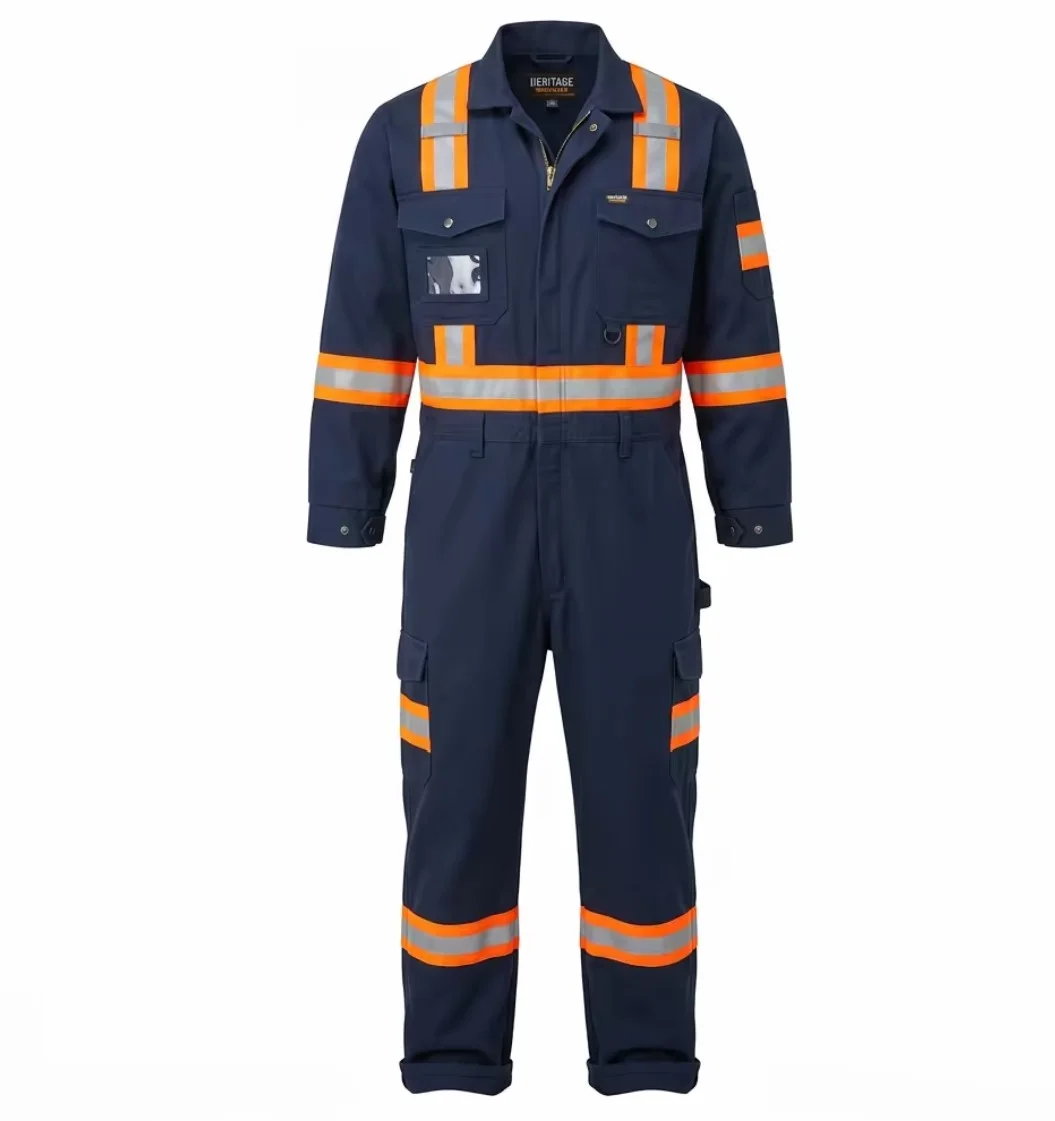
Flame retardant coveralls in Singapore are designed for workers who may be exposed to flame, heat, welding spatter and other thermal hazards during industrial work. Choosing the right coverall starts with identifying the actual hazard, checking the garment's tested standard and performance classification, and confirming that the design, fit and maintenance requirements suit the work being performed.
This is particularly important in Singapore's construction, marine, fabrication, oil and gas, petrochemical, manufacturing and heavy-industry environments. A coverall that looks heavy-duty is not automatically suitable for every thermal hazard. General heat and flame exposure, welding and electric-arc hazards are addressed by different standards and should not be treated as interchangeable.
ISO 11612:2015 remains the currently published international standard for clothing designed to protect against heat and flame, although ISO is developing a replacement edition. ISO 11611:2024 separately addresses welding and allied processes, while IEC 61482-2:2018 covers protective clothing against the thermal hazards of an electric arc.
Kaye Kaye Safety Solution supplies industrial overalls and coveralls as part of its head-to-toe PPE range in Singapore. Its current catalogue describes heavy-duty coveralls with flame-retardant properties, chemical-protection features and high-visibility retro-reflective accents, while separately referencing SS 473 / ISO 11612 for the workwear category. The company also provides B2B bulk sourcing, job-audit support and specific safety recommendations for industries including construction, welding, manufacturing, marine, oil and gas, and petrochemical operations.
For procurement teams, the correct buying sequence is therefore straightforward: identify the hazard, determine the required standard and performance level, verify the specific garment, assess fit and working conditions, and only then compare price and quantity.
Quick Answer: How Do You Choose Flame Retardant Coveralls in Singapore?
Choose flame retardant coveralls according to the workplace risk rather than the words "FR" on the product description. For general heat and flame exposure, ISO 11612 may be relevant. Welding work should be assessed against ISO 11611, while electrical arc exposure requires arc-specific standards such as IEC 61482-2. Buyers should also check the garment's individual performance classifications, fabric and construction, fit, laundering requirements, visibility needs and compatibility with other PPE.
A coverall that meets one standard should not automatically be assumed to meet another. The specific garment certification and performance marking should always be verified before purchase.
What Are Flame Retardant Coveralls?
Flame retardant coveralls are one-piece protective garments designed to reduce injury from specified heat and flame hazards by limiting flame spread and providing tested thermal protection according to the standard for which the garment has been evaluated.
They are not intended to make a worker fireproof.
Protective clothing works as one layer within a wider workplace-safety system. Engineering controls, safe work procedures, isolation, hot-work controls, equipment maintenance, permits to work and appropriate supervision may still be necessary depending on the task.
ISO 11612:2015 applies to protective clothing where limited flame spread is required and where workers may encounter radiant heat, convective heat, contact heat or molten-metal splash. The standard does not cover every specialised hazard a worker can encounter.
This is why a purchasing decision should begin with the work activity rather than with the appearance, thickness or price of the garment.
What Is the Difference Between Flame Retardant and Flame Resistant Coveralls?
The terms "flame retardant" and "flame resistant" are often used loosely or interchangeably in commercial discussions, so buyers should avoid relying on terminology alone.
Some protective fabrics achieve their flame performance through a treatment applied to the textile, while others use fibres whose flame-resistant characteristics are inherent to the material. Blended systems can also be designed to balance thermal protection with durability, weight, comfort or other properties.
Neither approach should automatically be considered superior simply because of the material description.
The more meaningful questions are whether the finished garment has been tested to the required standard, what performance classifications it achieved, whether those properties remain valid under the specified laundering conditions and whether the garment is appropriate for the workplace hazard.
A product described as "FR cotton," "treated FR," "inherent FR" or "fire-resistant workwear" should therefore still be checked against its actual certification and manufacturer documentation.
Why Are Flame Retardant Coveralls Important in Singapore Workplaces?
Flame retardant clothing provides an additional layer of protection when higher-level controls cannot completely remove a thermal hazard.
Under Singapore's workplace-safety framework, employers are expected to identify workplace hazards, assess risk and implement reasonably practicable controls. PPE should form part of that wider control strategy rather than being treated as the only protective measure.
This distinction is particularly important during welding, fabrication, hot work, petrochemical operations and industrial maintenance.
An FR coverall does not make an unsafe process safe by itself. A welding operation may still require screens, ventilation, hot-work procedures and other PPE. Work around flammable materials may require isolation and process controls. Electrical work can require an arc-flash assessment and additional electrical PPE beyond a flame-resistant garment.
The coverall addresses the residual risk that remains after those controls have been considered.
For procurement teams, this means there is little value in simply ordering the "strongest" or most expensive garment without understanding what workers will actually be exposed to.
What Certification Should Flame Retardant Coveralls Have?
There is no single certification that covers every flame, heat, welding and electrical hazard.
ISO 11612 is relevant to general heat-and-flame protective clothing. ISO 11611 is designed specifically for welding and allied processes. IEC 61482-2 addresses clothing used where workers face the thermal hazards of an electric arc.
A multi-standard garment can be tested to more than one of these requirements, but buyers should never assume that compliance with one standard automatically provides the protection described by another.
The correct certification should follow the workplace risk assessment.
What Does ISO 11612 Mean?
ISO 11612 specifies performance requirements for protective clothing designed for environments where workers may require limited flame-spread protection and protection against particular forms of heat or molten-metal exposure.
The currently published version is ISO 11612:2015. ISO states that this edition remains current, although an ISO/FDIS replacement is presently in the approval stage.
The important point is that a garment should not be described simply as "ISO 11612 certified" without considering the accompanying performance classifications.
Two garments referencing the same overall standard can have different tested capabilities against specific types of thermal exposure.
Kaye Kaye's current workwear catalogue displays SS 473 / ISO 11612 alongside its industrial overalls and coveralls. Buyers should still confirm the exact certification and classification of the individual garment being quoted rather than assuming every item in the category has identical performance.
What Do the ISO 11612 Performance Codes Mean?
Under the current ISO 11612:2015 framework, the marking uses letter codes to indicate the types of thermal exposure for which performance has been assessed.
A1 and A2 relate to limited flame spread under different ignition procedures. The B classification concerns convective heat, while C concerns radiant heat. D relates to molten aluminium splash, E to molten iron splash and F to contact heat.
Within the B-to-F categories, numerical classifications indicate performance within that particular hazard category. A higher classification within one letter should not be interpreted as proof of better performance against a completely different hazard. For example, stronger radiant-heat performance does not establish arc-flash protection or molten-metal performance.
This is one of the most important details for procurement teams.
A garment marked for limited flame spread and radiant heat is not necessarily suitable for molten-metal exposure. Likewise, ISO 11612 performance does not by itself establish that the garment is arc-rated.
When reviewing a quotation, ask for the complete garment marking and performance classification, not simply confirmation that the garment "meets ISO 11612."
What Does ISO 11611 Mean for Welding Coveralls?
ISO 11611 is specifically intended for protective clothing used during welding and allied processes with comparable risks.
The currently published edition is ISO 11611:2024. It covers hazards including small splashes of molten metal, short-duration flame contact and radiant heat generated by welding arcs. The standard also recognises different risk levels because welding processes can differ substantially in the heat and spatter they generate.
This means a general flame-resistant industrial coverall should not automatically be described as suitable welding PPE unless the garment's certification and classification support that use.
A worker carrying out occasional low-intensity welding can also have different requirements from someone performing intensive welding, cutting or related hot work for much of the shift.
The specific welding process should therefore form part of the garment-selection discussion.
Does Flame Resistance Automatically Mean Arc-Flash Protection?
No.
A flame-resistant garment is not automatically an arc-rated garment.
IEC 61482-2:2018 applies to protective clothing used where workers may be exposed to the thermal hazards of an electric arc. The standard does not address electric shock itself or every other consequence associated with an arc event, which means arc-rated clothing remains only one part of a wider electrical-safety system.
Arc performance can be expressed through test results such as ATPV, EBT or ELIM under relevant IEC methods.
For electrical workers, the practical lesson is simple: a garment that merely states "flame retardant" or even references a general heat-and-flame standard should not automatically be assumed to provide suitable arc protection.
If arc exposure is identified in the risk assessment, the employer should verify the garment against the appropriate arc-specific requirements.
Which FR Material Is Best?
There is no single FR fabric that is best for every Singapore workplace.
Treated cotton, inherent flame-resistant fibres and blended fabrics can all be used in protective clothing, depending on the garment design and intended performance.
The correct choice depends on the required standard, exposure level, garment weight, durability, laundering conditions, comfort and any additional workplace requirements.
A treated fabric may provide appropriate protection when manufactured and maintained according to its certified specification. An inherently flame-resistant fibre can provide its protective properties through the fibre structure itself. A blend may be engineered to provide a particular balance between protection, strength, comfort and wear characteristics.
Procurement teams should therefore avoid reducing the decision to "treated versus inherent."
The better question is: What protection has the finished garment demonstrated, and is that protection appropriate for our work?
What Features Should a Durable FR Coverall Have?
A durable FR coverall needs to provide the required protection without making normal work unnecessarily difficult.
Garment construction matters because coveralls are repeatedly stressed around the shoulders, elbows, knees, crotch, pockets and closures.
The design should allow workers to bend, climb, kneel and reach without excessive pulling across the garment. If the coverall restricts movement badly, workers may be more likely to unzip it, roll sleeves or wear it incorrectly.
Closures, seams, reflective materials and other garment components should also be compatible with the intended protective design.
Visibility can be important in workplaces involving vehicles, lifting operations, shipyards or low-light conditions. Kaye Kaye's current industrial-coverall category describes high-visibility retro-reflective accents alongside its flame-retardant workwear features.
However, visibility features and thermal performance should still be evaluated separately. A reflective strip does not establish flame protection, just as an FR fabric description does not establish high-visibility certification.
How Should FR Coveralls Fit?
A flame retardant coverall should fit securely while providing enough space for normal movement and any approved clothing layers worn underneath.
A garment that is too small can restrict bending, climbing and reaching. It can also pull around the front closure, shoulders or crotch when the worker moves.
An excessively oversized garment can create different problems. Loose fabric can interfere with movement, catch on surrounding equipment or affect how other PPE is worn.
Sleeves should continue to provide appropriate coverage when the arms are extended. Trouser legs should remain in position when the worker kneels or climbs, while the body of the garment should allow movement without forcing closures open.
For workforce orders, actual garment measurements are more useful than assuming everyone's normal T-shirt or casual clothing size will translate directly to an industrial coverall.
A sample fitting before a large order can therefore reduce sizing problems and worker rejection.
Can FR Coveralls Be Comfortable in Singapore's Hot Climate?
Comfort matters because Singapore's heat and humidity can increase the physical burden of protective clothing.
MOM's current heat-stress framework for outdoor work requires employers to consider measures such as acclimatisation, hydration, rest and shade, WBGT monitoring and work rescheduling according to heat conditions. On-site WBGT monitoring requirements apply to specified higher-risk sectors including larger construction sites, shipyards and the process industry.
A lighter coverall can reduce clothing burden, but weight should never be reduced below what is required for the identified hazard.
A lightweight certified garment may be appropriate where the risk assessment allows it. A lightweight garment without the required thermal performance is not an acceptable substitute.
The right approach is therefore to manage thermal hazard protection and heat stress together.
Employers should not attempt to solve heat stress simply by reducing PPE below the required protective level.
What Should Workers Wear Under FR Coveralls?
The clothing worn underneath an FR coverall should be considered part of the overall protective system rather than an unrelated personal choice.
The appropriate base layers depend on the hazard assessment, garment design, manufacturer's instructions and any testing or certification that applies to the clothing system.
Employers should avoid assuming that any everyday shirt or undergarment can be combined with protective clothing without consequence.
Where the protective performance depends on multiple layers, the complete system should be specified accordingly. Where the coverall manufacturer provides restrictions or recommendations on compatible garments, those instructions should be followed.
This is particularly important for electrical arc protection and other specialised thermal hazards where the performance of a clothing system can differ from that of one garment tested in isolation.
The safest procurement approach is therefore to ask whether the coverall is intended to be worn as a standalone outer garment or as part of a defined multi-layer system.
How Should Flame Retardant Coveralls Be Washed and Maintained?
FR coveralls should be cleaned according to the manufacturer's laundering and care instructions.
This matters because the protective performance is associated with a particular garment construction and maintenance regime.
Contamination, inappropriate laundry chemicals, excessive wear, damaged closures and unauthorised modifications can potentially affect the garment's continued suitability.
Employers should therefore treat laundering as part of the PPE-management programme rather than as ordinary uniform cleaning.
Before selecting a garment for a large workforce, it is useful to understand whether it can be washed through the company's existing laundry arrangement, whether specialised cleaning is required and how the garment should be inspected after repeated use.
Workers should also avoid casually altering certified garments. Cutting sleeves, replacing closures, attaching unsuitable materials or modifying the garment shape can change the protective system that was originally tested.
If customised logos, reflective materials or company identification are required, these should be discussed with the supplier before modification.
Which Industries Commonly Need Flame Retardant Coveralls in Singapore?
FR coveralls can be relevant across several Singapore industries, but the industry name alone does not determine the specification.
Workers within the same facility can face very different hazards.
A welder, maintenance electrician, process technician and warehouse employee at the same industrial site may all require different protective clothing.
This is why the work activity should always be assessed more precisely than the industry category.
What FR Coveralls Are Suitable for Welding and Fabrication?
Welding and fabrication workers can encounter flame, radiant heat, hot metal and welding spatter.
Where welding is the primary hazard, ISO 11611 is more directly relevant than relying only on a general heat-and-flame standard. ISO 11611:2024 recognises different levels of welding risk and is specifically designed for clothing used during welding and allied processes.
The type of welding, amount of spatter, working position and intensity of the task can all influence the clothing requirement.
A procurement team should therefore avoid ordering a generic "FR coverall" for welders without verifying whether the specific garment is tested for welding use.
What FR Coveralls Are Suitable for Oil, Gas and Petrochemical Work?
Oil, gas and petrochemical environments can involve potential flame exposure, process heat and other specialised risks depending on the task.
Some work areas may also introduce requirements relating to static control, chemical exposure or electrical hazards.
This means one ISO 11612 garment should not automatically be treated as a complete solution for every refinery or petrochemical worker.
The employer should identify the actual process hazards and determine which combination of standards is required for that role.
Kaye Kaye specifically positions its PPE offering around oil, gas and petrochemical refineries and supplies industrial coveralls as part of its broader workforce-protection catalogue.
What FR Coveralls Are Suitable for Marine and Shipyard Work?
Marine and shipyard work can combine welding, cutting, hot work, outdoor heat and physically demanding movement.
The garment therefore needs to provide the required thermal protection while remaining practical for climbing, bending and working around confined or complex structures.
Singapore's heat-stress requirements are also particularly relevant because shipyards are among the sectors subject to specified WBGT monitoring measures for outdoor work.
If welding is involved, ISO 11611 may be relevant. If other thermal hazards are present, additional garment performance may need to be considered.
The treatment of shipyard workers as one homogeneous group should therefore be avoided. Clothing should follow the actual work task.
What FR Coveralls Are Suitable for Construction?
Not every construction worker automatically requires flame-retardant clothing.
FR coveralls become relevant when the work itself creates a credible heat, flame or hot-work exposure that the risk assessment identifies.
Construction workers performing welding, cutting or related hot work can therefore have different clothing requirements from workers carrying out general building activities.
Where outdoor work is involved, thermal comfort and heat-stress management also become important.
The correct coverall should provide the protection required for the thermal hazard without introducing unnecessary burden beyond what the job demands.
What Clothing Is Required for Electrical Arc Hazards?
Electrical arc hazards require a separate assessment from general heat and flame exposure.
IEC 61482-2:2018 specifies requirements for clothing designed to protect electrical workers from the thermal effects of an electric arc. It does not cover electric shock itself, nor does it cover all other effects of an arc incident.
This means an electrical worker may require arc-rated clothing together with other electrical PPE and controls.
A general ISO 11612 coverall should not automatically be substituted where the identified risk requires arc-rated protection.
How Much Do Flame Retardant Coveralls Cost in Singapore?
There is no single standard price for flame retardant coveralls because the specification can vary substantially.
Material, certification, performance classification, garment construction, quantity, size range, reflective requirements, customisation and specialised multi-standard protection can all affect the final quotation.
A basic industrial garment designed for general heat-and-flame exposure cannot be compared fairly with a multi-standard garment intended for welding, electric arc or additional hazards simply because both are described as FR coveralls.
Kaye Kaye's current website operates primarily through direct enquiries for its industrial workwear rather than displaying one fixed retail price for every configuration.
For businesses, the most useful price comparison is therefore between garments that meet the same required specification.
A cheaper garment that does not meet the site's required protection is not a saving.
What Information Should You Give a Supplier Before Requesting an FR Coverall Quotation?
A useful quotation enquiry should begin with the job rather than the preferred garment.
Explain what the workers actually do, whether the exposure involves general flame and heat, welding, molten metal, electrical arc or another specialised risk.
If the company already has a required safety standard or site specification, provide that information rather than asking the supplier to guess.
The supplier should also know the work environment, whether high visibility is required, how long workers wear the garment, whether the job is mainly indoor or outdoor, and whether additional PPE needs to be worn with the coverall.
For a workforce order, quantity and size range are equally important.
If custom identification, embroidery or another form of branding is required, this should be discussed before the garments are modified.
Kaye Kaye currently describes its B2B offering as including bulk sourcing, job audits and specific safety recommendations, making this type of project information particularly relevant when approaching its sales team.
What Does Kaye Kaye Check Before Recommending an FR Coverall?
Based on Kaye Kaye's published B2B positioning, its purchasing discussion should begin with the industrial application and required safety performance rather than garment appearance alone.
The company's current site states that it provides job audits and specific safety recommendations and positions its PPE around scaffolding, construction, welding, marine, oil and gas, manufacturing and heavy-industry applications.
For an FR-coverall enquiry, useful information therefore includes the work activity, identified thermal hazard, applicable site specification, required quantity, sizing, visibility needs and the other PPE being used by the workforce.
Where welding, arc exposure or another specialised hazard is involved, the exact garment standard should be confirmed rather than inferred from the general coverall category.
This creates a more useful supplier conversation than simply asking, "What is your strongest flame-retardant coverall?"
Can Companies Customise FR Coveralls for Their Workforce?
Companies often need consistent branding, identification and sizing across their workforce, but protective clothing should not be modified casually.
Embroidery, patches, reflective components, heat-transfer materials and replacement closures can affect the design of the finished garment.
Where customisation is needed, the employer should confirm with the supplier that the proposed modification is appropriate for the protective garment.
Kaye Kaye's workwear heritage is particularly relevant to this requirement. Its current website traces the KK workwear story to founder Mr. Ng Chee Chow around 1981 and describes an ongoing emphasis on garment craftsmanship, safety, comfort and durability.
For bulk buyers, combining workwear knowledge with broader PPE sourcing can help coordinate garment requirements with footwear, gloves, helmets and fall-protection equipment used by the same workforce.
How Should Companies Size FR Coveralls for a Workforce?
Sizing should be planned before a bulk order is finalised.
Workers with the same usual clothing size can have different body proportions, and industrial coveralls need sufficient room for movement, bending, climbing and any approved clothing layers underneath.
A procurement team should therefore collect suitable worker measurements and compare them with the size information for the selected garment.
For a large workforce, sample fitting can be useful before every garment is ordered.
This gives the employer an opportunity to confirm sleeve length, leg coverage, movement through the shoulders and crotch, and compatibility with other PPE.
Once an approved model and sizing structure are established, replacement ordering becomes easier and more consistent.
When Should FR Coveralls Be Replaced?
FR coveralls should be inspected regularly and removed from service when damage, contamination or deterioration could compromise their intended protective performance.
Serious tears, abrasion, failed seams, damaged closures or contamination that cannot be removed under the manufacturer's approved cleaning instructions can all justify retirement.
There is no reliable universal rule that every FR coverall must be replaced after the same number of months or washes.
A garment worn occasionally in a controlled environment will experience very different wear from one used every day for fabrication, welding or offshore work.
The garment manufacturer's inspection, care and retirement criteria should therefore guide the replacement programme.
Workers should also be encouraged to report damaged PPE rather than continuing to use a garment simply because it remains physically wearable.
Why Consider Kaye Kaye Safety Solution for FR Coveralls in Singapore?
Kaye Kaye Safety Solution provides industrial coveralls as part of a broader head-to-toe PPE offering rather than treating workwear as an isolated category.
Its current catalogue describes heavy-duty overalls and coveralls with flame-retardant properties, chemical-protection features and retro-reflective accents, and separately displays SS 473 / ISO 11612 for its workwear category. Buyers requiring chemical protection should confirm the exact chemical-protection standard of the particular garment because ISO 11612 itself is a heat-and-flame standard.
Kaye Kaye also supplies safety footwear, head protection, protective gloves and fall-protection systems for industries including construction, welding, manufacturing, marine and oil and gas.
Its current B2B positioning includes bulk sourcing, workforce protective deployment, job audits and specific safety recommendations.
For procurement teams responsible for several PPE categories, this can make it easier to consider how the coverall interacts with the worker's broader protection rather than purchasing each item independently.
The practical value is not simply that Kaye Kaye sells an FR coverall. It is that the purchasing discussion can begin with what the worker needs protection from and what specification the workplace requires.
Final Thoughts: How Should You Choose FR Coveralls in Singapore?
Choosing flame retardant coveralls in Singapore should begin with the hazard and performance requirement, not the fabric name, garment weight or lowest quotation. ISO 11612:2015 remains the currently published international standard for clothing protecting against specified heat-and-flame hazards, while ISO is developing its replacement edition. ISO 11611:2024 separately addresses welding and allied processes, and IEC 61482-2:2018 covers protective clothing against the thermal hazards of electric arc exposure. Those distinctions matter because one garment can be suitable for general industrial heat exposure without being appropriate for welding or electrical arc work. Procurement teams should also look beyond the standard number itself. Under ISO 11612, the individual performance codes tell the buyer which forms of thermal exposure have actually been assessed. Fit, movement, laundering, layering, heat stress and compatibility with other PPE all influence whether the garment will remain practical in real working conditions. Kaye Kaye Safety Solution's current workwear catalogue includes industrial coveralls with flame-retardant features and references SS 473 / ISO 11612, alongside broader PPE for construction, welding, manufacturing, marine, oil and gas, and other higher-risk industries. Its B2B offering also includes bulk sourcing, job audits and specific safety recommendations. For an employer purchasing for one worker or an entire crew, the most useful buying question is therefore not “Which FR coverall is strongest?” It is “What thermal hazard are our workers actually exposed to, which tested performance is required for that hazard, and which garment can provide that protection while still being worn, maintained and integrated correctly with the rest of our PPE system?”
Frequently Asked Questions About Flame Retardant Coveralls in Singapore
Read More
Frequently Asked Questions
Need On-Site Safety Assistance?
Speak directly to our safety specialists for transparent quotes and fast dispatch across Singapore.